

There is a trade-off with regard to camera position and the collection of mood data. Many security cameras are positioned to get the widest possible view of a large area, to get the best coverage of a crowd. Such a wide view is optimal for measuring density and flow, but can be problematic for mood data. DCM Mood analysis does not use facial recognition technology, and does not track individuals, instead using pattern matching for ‘smiles and frowns’.
This does however require a sufficiently detailed view of crowd faces to be able to distinguish basic facial features like the eyes nose and mouth. The further away the camera is from a face, the less accurate the mood determination will be, and beyond a certain distance, the software will not be able to determine a mood rating. This distance varies significantly with camera quality, resolution and zoom capability, but generally if a camera is mounted more than four meters from the ground, or more than fifty meters from the main subject, its ability to collect mood data may be limited.
When planning each camera setup, you should consider how interested you are in the mood of the crowd at that location. Mood can be a powerful early indicator of safety issues, even when crowd density is relatively low, and can be particularly important in situations like entrance queues, or bar areas.
Using the same example as before, but now looking at the mood results (recall it is a graph of risk, so the higher the number more negative the average detected mood), we can see a change in the underlying crowd mood here.
It can be seen that after a period where despite short term changes (likely due to events on stage) the mood was relatively stable, there has been a significant and sustained deterioration in average mood in the last 5 minutes of this hour of data. Such shifts may be worthy of investigation.
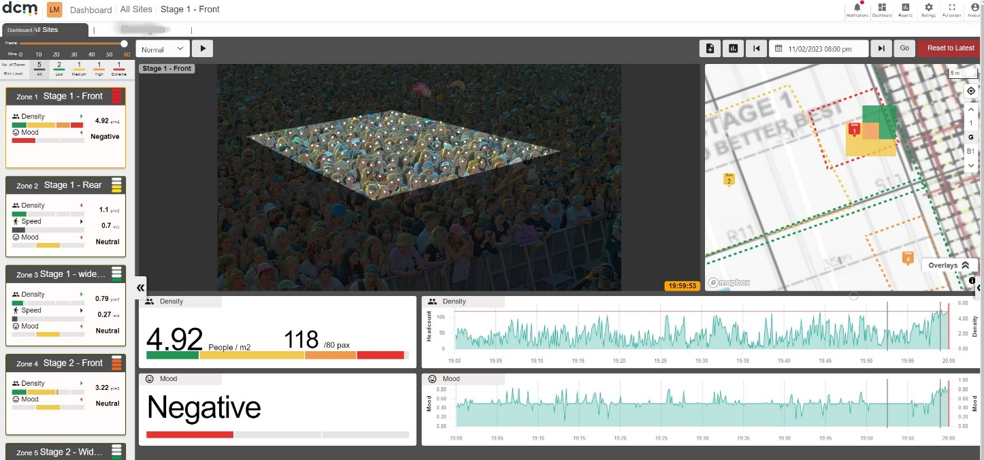
Even if a fixed camera is capable of zooming, doing so may detract from its value for monitoring the crowd overall. If multiple cameras are available for a busy area, consider dedicating one to a wider view for general security monitoring and another to a tighter view to monitor mood. If cameras with a “Pan/Tilt/Zoom (“PTZ”) function are available, these can be used by DCM to do both, but at the cost of continuous movement of the view, which may be undesirable.
PTZ cameras can optionally be set up during the calibration process to alternate between a wide view, and to zoom into specific areas to detect more detailed mood information. Similarly to setting up multiple scenes with a single camera, this mode requires the camera to move and zoom continuously during operation. This will decrease the frequency of density and flow data sampling, and may compromise other uses, such as general crowd monitoring. It will also use more power, which may be a significant factor for mobile or solar powered installations.
Mood measurement is also not possible if people are wearing face coverings or possibly where light levels are low and the camera does not have good night vision capabilities.
You may optionally choose to configure a PTZ camera deliberately as a fixed camera (called “IP Other” in the DCM configuration screen). This will allow the camera to remain static , while still collecting information for all metrics. Mood data quality will then depend on the distance to the subject.
The next section will describe the calibration process in detail.
There is another troubleshooting guide at the end of the calibration section.