In situations where the primary concern is potential overcrowding and crowd density, especially for standing crowds viewing a stage or event behind static barriers, it is recommended to have a single dedicated camera zoomed in to a relatively small area of less than 50m squared, where the maximum density is expected, or that will be representative of the overall crowd density. The most accurate density measurements can be obtained in such situations by calibrating a relatively small, square or rectangular area and calibrating it accurately before the event. Consider allocating or installing a small inexpensive fixed camera to do this if possible and having another PTZ camera dedicated to collecting a wider view and monitoring incidents. Camera calibrations can only be done for one area for each camera, and for density a smaller area tends to give the most accurate results. Sharing density measurements with a camera that may be moved to monitor incidents during the event will mean the measurements will be interrupted, possibly during a critical stage.
DCM headcount and density measurements can operate at a wide variety of angles of view, from around 20 degrees to almost vertical. If there is flexibility to install or adjust camera positions this may be useful in some situations. For situations such as concerts, where occlusion from raised hands, smoke or other obstacles is expected, a higher camera position will reduce this issue. In such situations, consider setting up a overhead view camera to monitor density with minimum occlusion, and a separate camera lower down with a good view of faces to measure mood.
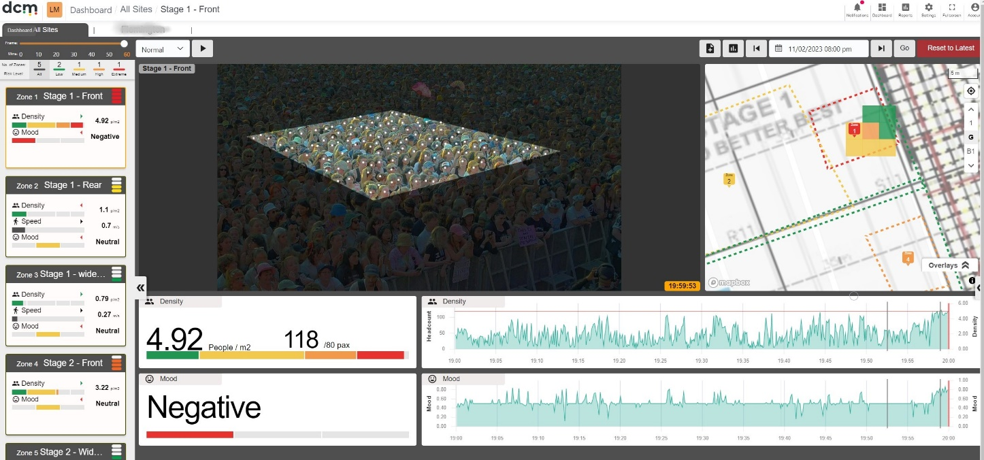
Example: An ideal configuration for dense, relatively static crowds, using a zoomed dedicated measurement in a small but representative area. This camera is in ‘headcount’ mode. The zone has turned red, and is about to alarm, as density is approaching unsafe levels, and it has begun to affect crowd mood.