

Camera views
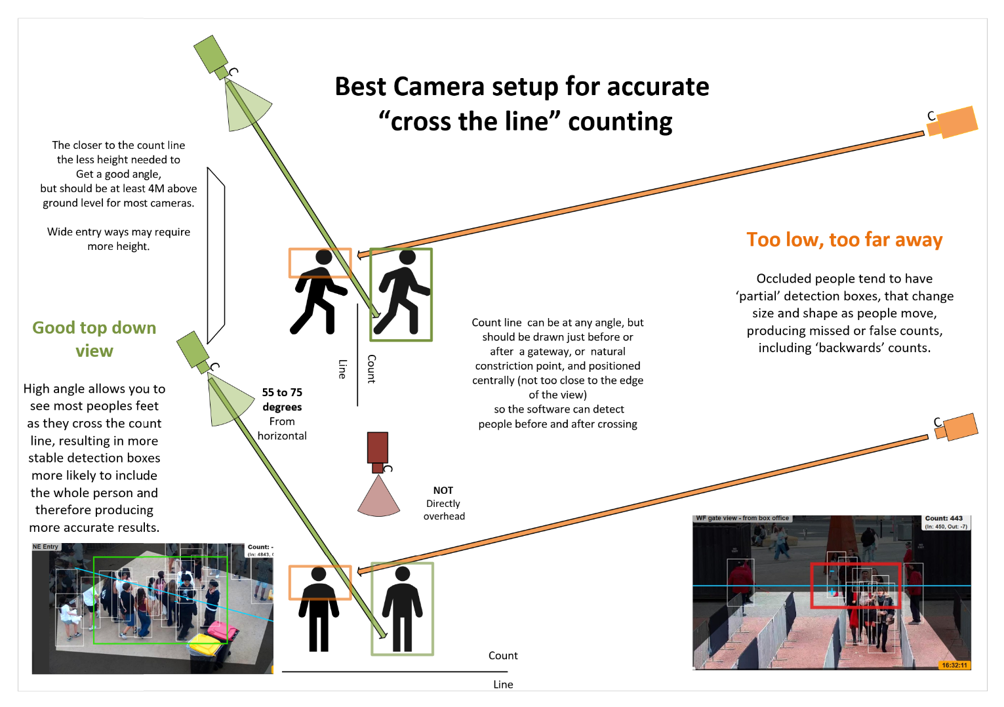
The Cumulative Counting option requires a clear camera view of each entry point or gate to be monitored, ideally from a mount point at least three meters high looking down at the incoming patrons at approximately a 55 to 75 degree down angle. This is to ensure that patrons entering or exiting are not completely obscured by people in front of them when the crowd gets dense, which would result in missed or false counts. A camera looking directly down at 90 degrees is not suitable.
As a general rule of thumb – for line counting the camera view should be high enough to see most peoples feet to get the most accurate across the line counts.
The exact pattern of potential errors is difficult to predict as it depends on angle, crowd density and behaviour. With slow moving queues coming direct at a camera with too low a view, that mostly sees people above the waist – the middle of the detected person can bounce up and down as people move relative to each other. When the 'detection box bounces around close to the count line, it can tend to produce random extra false in and out counts.
A camera directly overhead makes the profile of people difficult for the software to identify clearly and will under count.
The requirements for the camera itself are identical to standard DCM, in that it should be IP based, have a resolution of at least 1080p and have a reasonable quality lens.
If the intent is to get a running total of patrons within the space, then all entry points need to be monitored. The standard headcount feature using camera views of the interior space, does have an option to cope with incomplete coverage, by using a formula to estimate areas not covered by camera views. For example if only 40% of the interior floor space is covered by cameras – the standard headcount report can be configured to multiply this sample using expected distributions to estimate current attendance. Because of the more variable nature of ‘Line crossing’ based counting – it is not generally possible to estimate ingress rates if some entrances are not covered. Therefore in situations where few cameras are available, or can be easily installed – consider using standard DCM capacity reports with an estimation element rather than Cumulative Counting.
A visual guide to placing entry cameras for best line counting results.
Clear counting lines
When planning where to place the counting lines, it is important to place them in a position free of obstructions to the view, and where people are unlikely to loiter for extended periods. In general, if there is a gate or security screening position for ingress, such as a bag checking station, it is better to place the count line behind this (counting people on the internal side as they exit bag check) rather than in front of the gate.
Anyone loitering on the count line itself, will produce false entry counts. A common source of this is security staff stationed at the gate. Therefore placing the count line behind the position where staff are expected to stand – and where patrons are moving more freely is optimal.
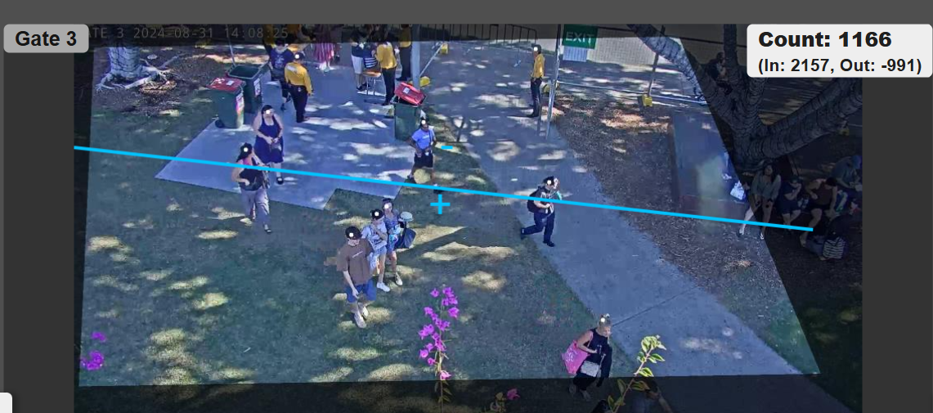
In the above example, you see the blue counting line placed behind the gate, as patrons exit the security check, and away from loitering staff (in yellow) or any potential obstructions or moving objects (line rubbish bins), that may cause false counts or obstruct the view.
Count lines must cover full width of entry point
It is important that the camera view is wide enough to cover all possible entry or exit paths. If it is possible by any means to enter or exit the gate, without crossing the blue count line, the count will become inaccurate.
This is typically not a big issue for doorways or permanent gates, where the entry point is not very wide and is well defined.
It can become more significant in situations where the entry point is made up of temporary fencing, especially if that fencing is moved, for example between ingress and egress. Care needs to be taken not to open up access beyond the end of the count line, or people will be missed as they exit. In that situation, when viewing the overall reports – the total number of patrons remaining in the venue would be overestimated.
Another situation which can cause the same issue – is if additional entry or exit points are created to cope with unexpected crowd surges that are not covered by the counting cameras.
Similar issues can arise if any obstruction covers part of the view of the count line. Cameras should be placed where possible, so that objects such as flags or temporary signage will not obstruct part of its view and allow people to cross the count line without being visible to the camera.
Count lines must have adequate lighting
Aside from physical obstructions light levels may also be a consideration. Camaras vary widely in their ability to cope with low light or extreme shadows or contrast. In general, count lines should be positioned at points with at least some constant overhead light for best results.
If the above requirements are met, then Cumulative Counting can achieve an accuracy rate of over 95%.